
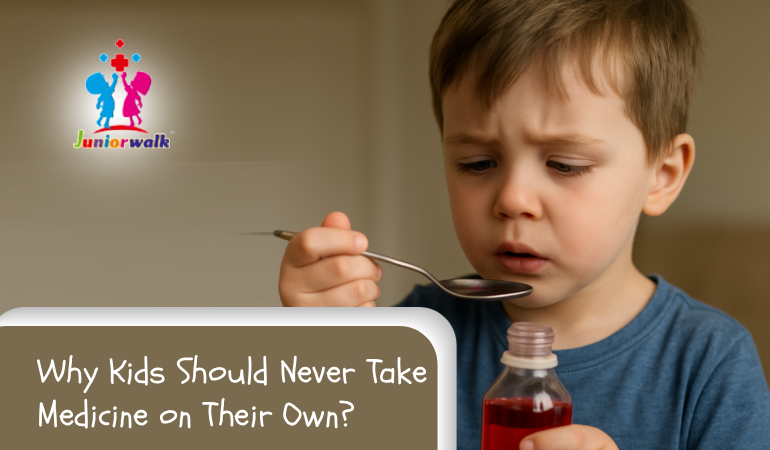
In terms of maintaining children’s health, it is usually vital to administer them the appropriate medicine at the proper time. However, there is one principle that should never be violated: children should never be allowed to administer their own medication. No matter whether it is an over-the-counter cold syrup, an over-the-counter pain reliever, or even a prescription drug, unsupervised medication may easily result in risky outcomes. Most parents do not realize the curiosity that children have and how misleading they can be with the instructions on dosage.
This blog discusses the reasons why children should be under strict adult care whenever taking any form of medication.
1. Kids Don’t Understand Dosage and Safety
Adults are aware that drugs should be incorporated in certain doses. Such limits, however, are not comprehended by children. Children cannot distinguish between the medicines that resemble candies, coloured pills, or syrups that have a sweet taste. Their inherent interest inclines them to the tendency to use medications like snacks, which is even more hazardous given the unsupervised access.
2. Risk of Severe Allergic Reactions
There is training on how to check ingredient lists or seek the advice of a doctor before administering a new medicine to their parents and caregivers.
When a child administers the wrong medicine independently, he or she can experience:
- Rashes or skin swelling
- Breathing difficulties
- Severe itching
- Extreme cases of allergy
Although the child might have taken medication, before that, the dosage is likely to trigger when taken in the wrong amounts.
3. Side Effects Go Unnoticed
Although adults are aware of the symptoms to watch out for, children have little chance of observing the red flags. They do not know how or are too frightened to complain.
Supervision helps adults:
- Observes vomiting, excessive drowsiness, or irritability
- Recognize the presence of allergic reactions
- Ensure that the child is responding well
- Discontinue the drug immediately in the event of something wrong.
4. Medicines May Interact with Other Substances
Children may fail to recall or realize that they should not take more than one medicine at a time. As an illustration, the combination of cold syrup and another fever medication could be harmful due to the presence of negative drug interactions.
Kids are not aware of:
- Which medicines cannot be taken together
- Which medicines require food
- Which should be avoided if they have certain health conditions
5. Accidental Poisoning Is a Serious Risk
Every year, millions of emergencies are reported worldwide due to children accidentally swallowing medications. Children who raid cupboards, bags, or drawers can also stumble across tablets or syrups and take them out for curiosity.
To a child:
- The pill is colourful and resembles a sweet
- A syrup smells like juice
- Bottled pills sound like fun
6. Kids May Misread Labels or Instructions
Medical labels may not be comprehended by even children who are old enough to read. Such terms as dosage, prescription only can be misunderstood easily.
A child might:
- Use medication that is used in adults
- Mistake day time doses with night time doses
- Confusion of spoons or measurements
- Take expired medicine
Adequate supervision also ensures that medication is administered safely and with the appropriate process on each occasion.
7. Builds Good Safety Habits for Life
Educating children about medicine being no toy starting at a young age creates life long habits of safety. Children raised to understand that medicine is an adults-only domain will be less likely to try to get high off drugs or abuse them later in life. Explicit policies and a set of instructions can make children aware of limits and appreciate how severe medicines are.
There is no exception when it comes to children not taking medicine themselves. They have little knowledge about dosage, side effects and safety which may cause severe and even fatal outcomes. It’s our duty as parents to lock up the drugs, to tell them why they shouldn’t take them except under supervision, and to ensure that every dose they consider taking is safe and appropriate. With appropriate guidance, it is possible to protect their health and develop responsible habits throughout their lifetime.